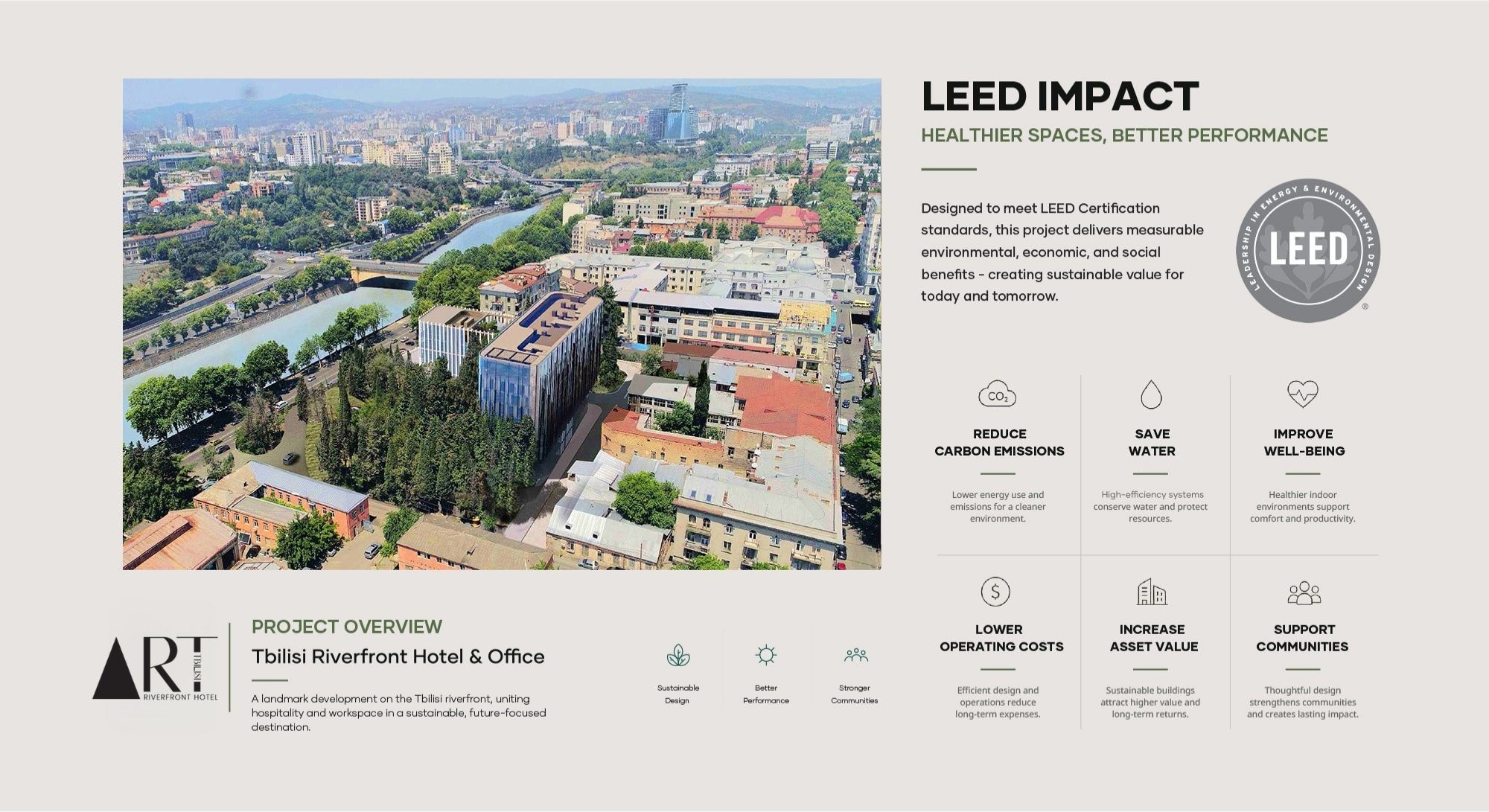
PASHA Real Estate Group: LEED Certification System

PASHA Real Estate Group is apremier developer recognized for delivering ultra-luxury residential andcommercial projects that define modern elegance and sophisticated living. TheGroup's prestigious portfolio includes iconic landmarks such as The CrescentResidences, The Ritz-Carlton, Baku, and Four Seasons Hotel Baku,as well as international projects like Portonovi in Montenegro and MandarinOriental in Bodrum.

With a vision focused on"Elevated Spaces for Life & Business," PASHA Real Estate Groupcombines architectural excellence with operational innovation. The TbilisiRiverfront Office & Hotel represents the Group's strategic expansion intoGeorgia, bringing its signature standard of luxury to the capital while settinga new benchmark for sustainable development in the region.

Environmental challenges suchas global warming, climate change, and access to clean water have emerged asincreasingly critical concerns in contemporary society. Research demonstratesthat buildings account for approximately 40% of global energy consumption and30% of water usage, while individuals spend approximately 90% of their lives inindoor environments. This reality underscores the imperative need forresource-efficient, high-performance buildings designed with environmentalstewardship as a core principle.

The design of environmentallyresponsible buildings prioritizes factors that directly influence human healthand well-being, including indoor air quality, natural daylighting, thermal andhumidity control, and comprehensive waste management. These buildings arestrategically designed to minimize environmental impacts throughoutconstruction and operational phases, while simultaneously enhancing occupantcomfort and productivity, and reducing both health-related expenses andoperational costs. In general, green buildings achieve approximately 30%greater energy efficiency compared to conventional structures and realize watersavings of up to 50% through the implementation of high-efficiency fixtures andsustainable landscape design practices.

LEED (Leadership in Energyand Environmental Design) is an internationally recognized green buildingrating system developed by the U.S. Green Building Council (USGBC). The currentiteration, LEED v4, encompasses diverse building typologies throughout theirlifecycle, from design through operations, including:

●      Building Design and Construction (BD+C)

●      Commercial Interiors (CI)

●      Existing Buildings: Operations & Maintenance (O+M)

●      Homes

●       Neighborhood Development

Within the LEED framework, projects must first satisfy mandatoryprerequisites before accumulating points through credit achievement. Buildingsare subsequently awarded certification levels—Certified, Silver, Gold, orPlatinum—based on total points earned.

●      Certified: 40-49 points

●      Silver: 50-59 points

●      Gold: 60-79 points

●       Platinum: 80-110 points
Riverfront Hotel Tbilisi

LEED v4 Building Design &Construction: New Construction

Our project is registeredunder the LEED v4 Building Design & Construction, New Constructioncertification system, which evaluates projects across nine principalcategories: Integrative Process, Location and Transportation, SustainableSites, Water Efficiency, Energy and Atmosphere, Materials and Resources, IndoorEnvironmental Quality, Innovation, and Regional Priority.

Sustainability Vision and LEED Green Building Strategies

As the Riverfront HotelTbilisi Building project, we have embraced a comprehensive sustainabilityframework throughout our design and construction processes, aimed at minimizingenvironmental impacts, optimizing natural resource utilization, and deliveringsuperior indoor environmental quality to our guests. In alignment with thiscommitment, our project has been registered for certification under LEED v4BD+C: New Construction, a globally recognized green building certificationsystem.

LEED incorporatesperformance-based criteria across numerous domains, including energy efficiency,water stewardship, material selection, indoor environment quality, andsustainable site development. The Riverfront project is designed to performhighly in most of these criteria. The following sections highlight theprincipal sustainability strategies implemented within our Project.

Integrative Design Process

Our project was developedthrough an integrated design approach involving collaboration amongarchitectural, mechanical, electrical, landscape, and sustainabilityconsultants, ensuring optimization of the building's energy and waterperformance from the earliest design phases.

Location & Transportation Strategies

●      Site selection within an established infrastructure areaminimizes environmental disturbance during both project construction andbuilding operations.

●      The project site is located within convenient walking distanceof metro and bus public transportation stations. Frequent transit service todiverse destinations throughout the day is intended to reduce carbon emissionsassociated with private automobile usage.

●      Numerous essential services—including markets, bankingfacilities, and dining establishments—are situated within comfortable walkingdistance of the Project.

●       Six parking spaces within theparking facility have been equipped as EVSE-ready stations to support electricvehicle charging infrastructure.

Sustainable Sites

●      A comprehensive construction activity pollution prevention planhas been implemented to effectively control dust, sediment runoff, and airquality impacts during construction operations.

●      Over 25% of the project campus area consists of vegetatedlandscape. Plant selections emphasize biodiversity to support habitat creation,while prioritizing species that offer both aesthetic appeal and reduced waterrequirements.

●      Open spaces provide building users with safe,pedestrian-prioritized hardscape areas complemented by visually striking greenspaces designed to enhance user experience.

●       High solar reflectance index(SRI) roofing materials have been specified for roof surfaces. Additionally,the abundance of planted landscape areas and the predominant use ofmedium-to-light colored hardscape materials work synergistically to mitigatethe urban heat island effect.

Water Efficiency

●      Plumbing fixtures specified are high-efficiency models,achieving greater than 40%reduction in indoor water consumption compared to standard baseline buildings.

●       Landscape water consumptionhas been reduced by more than 50% compared to the EPAct baseline throughstrategic emphasis on water efficient plant species within landscape areas.

Energy & Atmosphere

●      Energy-efficient lighting, heating, cooling, ventilation, andbuilding automation systems have been selected in accordance with the AmericanSociety of Heating, ASHRAE Standard 90.1-2010 requirements. This approach yieldsenergy performance improvements exceeding 20% compared to ASHRAE baselinevalues.

●      Building energy consumption will be continuously monitoredthrough energy analyzers and calorimeters, enabling immediate detection andremediation of potential inefficiencies and operational anomalies.

●       Refrigerants have beenselected based on low environmental impact criteria, minimizing global warmingpotential and ozone depletion potential.

Materials & Resources

●      Building material selections have been prioritized based onadherence to environmental impact reduction principles and sustainabilityobjectives.

●      Recycling collection points have been strategically positionedthroughout various building locations, complemented by a centralized wastemanagement area to facilitate comprehensive recycling programs.

●      A substantial portion of construction waste has been diverted torecycling or reuse channels, thereby significantly reducing landfill disposalquantities and minimizing associated environmental impacts. Construction wastestreams have been meticulously tracked and documented throughout theconstruction process.

●       A significant proportion ofproject materials possess Environmental Product Declarations (EPDs), enablingtransparent evaluation of environmental impacts across the complete materiallifecycle.

Indoor Environmental Quality

●      To safeguard occupant health and comfort, stringent protocolshave been established to ensure that volatile organic compound (VOC) emissionlevels from construction chemicals utilized in interior spaces—including paintsand primers—remain in strict compliance with internationally recognized limits.This rigorous standard has been uniformly applied to flooring and insulationmaterial selections.

●      Design criteria compliant with ASHRAE Standard 62.1-2010 havebeen fully integrated into the project to ensure optimal ventilation ofinterior spaces. Fresh air supply rates delivered to building interiors exceedthe minimum requirements established by ASHRAE Standard 62.1-2010, thereby ensuringthat building occupants experience a healthy and comfortable indoorenvironment.

●      Thermal comfort conditions compliant with ASHRAE Standard55-2010 have been achieved in both individual and multi-occupant spaces. Thisensures that summer and winter design temperature ranges established at projectinception are maintained, thereby supporting occupant comfort.

●      Energy-efficient lighting fixtures have been specified forinterior illumination. Additionally, long-life LED lamps with high ColorRendering Index (CRI) values and low glare characteristics have been selectedto enhance occupant comfort.

●      During the design phase, priority was given to access todaylight and outdoor views for users in frequently used areas in the interiorareas.

●       Throughout the constructionphase, comprehensive protective measures have been implemented and rigorouslymonitored to safeguard completed building sections, stored materials designatedfor installation, and HVAC ductwork systems, while maintaining exemplaryconstruction site cleanliness standards.

Riverfront Office Tbilisi

LEED v4 Building Design &Construction: Core & Shell

Our project is registeredunder the LEED v4 Building Design & Construction, Core & Shellcertification system, which evaluates projects across nine principalcategories: Integrative Process, Location and Transportation, SustainableSites, Water Efficiency, Energy and Atmosphere, Materials and Resources, IndoorEnvironmental Quality, Innovation, and Regional Priority.

Sustainability Vision and

LEED Green Building Strategies

The Riverfront Office TbilisiBuilding exemplifies our dedication to integrating sustainable practices acrossall phases of project development and construction. Our primary objectivescenter on reducing ecological footprints, maximizing efficient use of naturalresources, and ensuring exceptional indoor air quality and comfort for alloccupants. To formalize this vision, we have pursued certification through theLEED v4 BD+C: Core & Shell rating system, an internationally acclaimedbenchmark for sustainable building design and Performance.

The LEED framework evaluatesprojects through rigorous, performance-oriented standards spanning multipleenvironmental categories: energy conservation, water management efficiency, responsiblematerial sourcing, enhanced indoor environmental conditions, and ecologicallysensitive site planning. Our Riverfront development has been strategicallydesigned to achieve superior outcomes across the majority of these evaluationcriteria. The subsequent sections provide an overview of the key environmentalstrategies and sustainable solutions that define this Project.

Integrative Design Process

The Riverfront Office Tbilisidevelopment emerged from a cross-disciplinary collaborative process thatbrought together specialists in architecture, mechanical engineering,electrical systems, landscape design, and environmental sustainability. Thisholistic methodology enabled our team to establish energy-efficient andwater-conservation targets during the conceptual design phase, ensuring thesesustainability goals were embedded into the project's foundation rather thanadded retrospectively.

Location & Transportation Strategies

●      Choosing a development location within a fully serviced urban area—completewith established utilities and infrastructure—significantly limits ecologicaldisruption throughout construction activities and the building's operationallifespan.

●      The office's strategic positioning provides immediate pedestrianaccess to both metro stations and bus transit hubs. High-frequency publictransportation services connecting to multiple urban destinations throughoutoperational hours are expected to substantially decrease greenhouse gasemissions from personal vehicle dependency.

●      A comprehensive range of daily amenities—encompassing groceryretailers, financial institutions, and food service venues—lies within a shortwalk from the property, promoting pedestrian activity and reducing vehiculartrips.

●       Within the parking structure,six designated spaces have been pre-wired and configured as Electric VehicleSupply Equipment (EVSE)-ready installations, facilitating future expansion ofcharging capabilities for electric mobility.

Sustainable Sites

●      A comprehensive construction activity pollution prevention planhas been implemented to effectively control dust, sediment runoff, and airquality impacts during construction operations.

●      Over 25% of the project campus area consists of vegetatedlandscape. Plant selections emphasize biodiversity to support habitat creation,while prioritizing species that offer both aesthetic appeal and reduced waterrequirements.

●      Open spaces provide building users with safe,pedestrian-prioritized hardscape areas complemented by visually striking greenspaces designed to enhance user experience.

●       High solar reflectance index(SRI) roofing materials have been specified for roof surfaces. Additionally,the abundance of planted landscape areas and the predominant use ofmedium-to-light colored hardscape materials work synergistically to mitigatethe urban heat island effect.

Water Efficiency

●      All installed plumbing fixtures demonstrate superior efficiencycompared to conventional baseline building standards. Additionally, waterconsumption limit requirements have been established for water fixtures to beinstalled by tenants within their leased spaces. Through this comprehensiveapproach, the building is designed to achieve high-performance technology thatdelivers indoor water savings exceeding 45%.

●       Through deliberateprioritization of water-conserving plant varieties throughout landscaped zones,irrigation water demand has been curtailed by more than 50% relative to theEPAct reference baseline.

Energy & Atmosphere

●      The project's lighting systems, HVAC equipment, and buildingmanagement technologies have been procured in full compliance with ASHRAEStandard 90.1-2010 criteria. Additionally, tenants have been informed through acomprehensive tenant manual regarding the selection of energy-efficientlighting fixtures and mechanical equipment. Lease agreements incorporateprovisions that promote efficiency-enhancing practices and operationalstandards. This strategic specification delivers energy efficiency gains surpassing 13% above ASHRAEbaseline performance metrics.

●      Monitoring of building energy utilization will be facilitatedthrough integrated energy analyzers and calorimetric instrumentation, allowingfor prompt identification and resolution of performance degradation oroperational irregularities.

●       Refrigerant selection forcore building systems has been guided by stringent environmental impactcriteria, prioritizing substances with minimal global warming potential (GWP)and negligible ozone depletion characteristics.

Materials & Resources

●      Material procurement strategies for the building haveprioritized alignment with environmental impact mitigation principles andlong-term sustainability goals.

●      Occupants are required to designate recycling collectionstations within their tenanted spaces. Comprehensive guidelines detailing wastecategorization protocols and appropriate sorting methodologies for recyclablematerials are provided through the tenant handbook. All recyclables gatheredfrom throughout the facility will be consolidated at the central wastemanagement area before being conveyed to accredited recycling serviceproviders. This practice contributes to the reduction of material resourceconsumption.

●      A considerable volume of construction debris has been redirectedtoward recycling and reuse pathways, substantially diminishing landfill-boundwaste volumes and curtailing related environmental consequences. Rigorousdocumentation and monitoring of construction waste categories were maintainedacross all project phases.

●       A notable amount of materialsincorporated into the project has Environmental Product Declarations (EPDs),facilitating comprehensive transparency in assessing environmental implicationsthroughout the entire material life cycle.

Indoor Environmental Quality

●      Protecting occupant well-being and comfort has driven theimplementation of rigorous controls ensuring that volatile organic compound(VOC) emissions from interior construction chemicals - such as paints andprimers - remain within internationally established thresholds. These exactingspecifications have been consistently extended to flooring systems and thermalinsulation products.

●      Ventilation design parameters conforming to ASHRAE Standard62.1-2010 requirements have been comprehensively integrated throughout theProject. Sufficient fresh air volumes are provided to each tenant space to meetoffice usage requirements. Clean air distribution capacities exceed thebaseline thresholds mandated by ASHRAE Standard 62.1-2010, thereby ensuring ahealth-promoting and comfortable indoor environment for building occupants.

●      Priority has been given to access to daylight and outdoor viewsfor occupants in frequently utilized interior zones.

●       During the constructionexecution phase, rigorous protection protocols were established andcontinuously supervised to preserve completed building components, on-sitematerials awaiting installation, and mechanical ventilation infrastructure,while simultaneously upholding superior housekeeping practices across theconstruction site.

WhatsApp
i
Связаться
Позвонить